
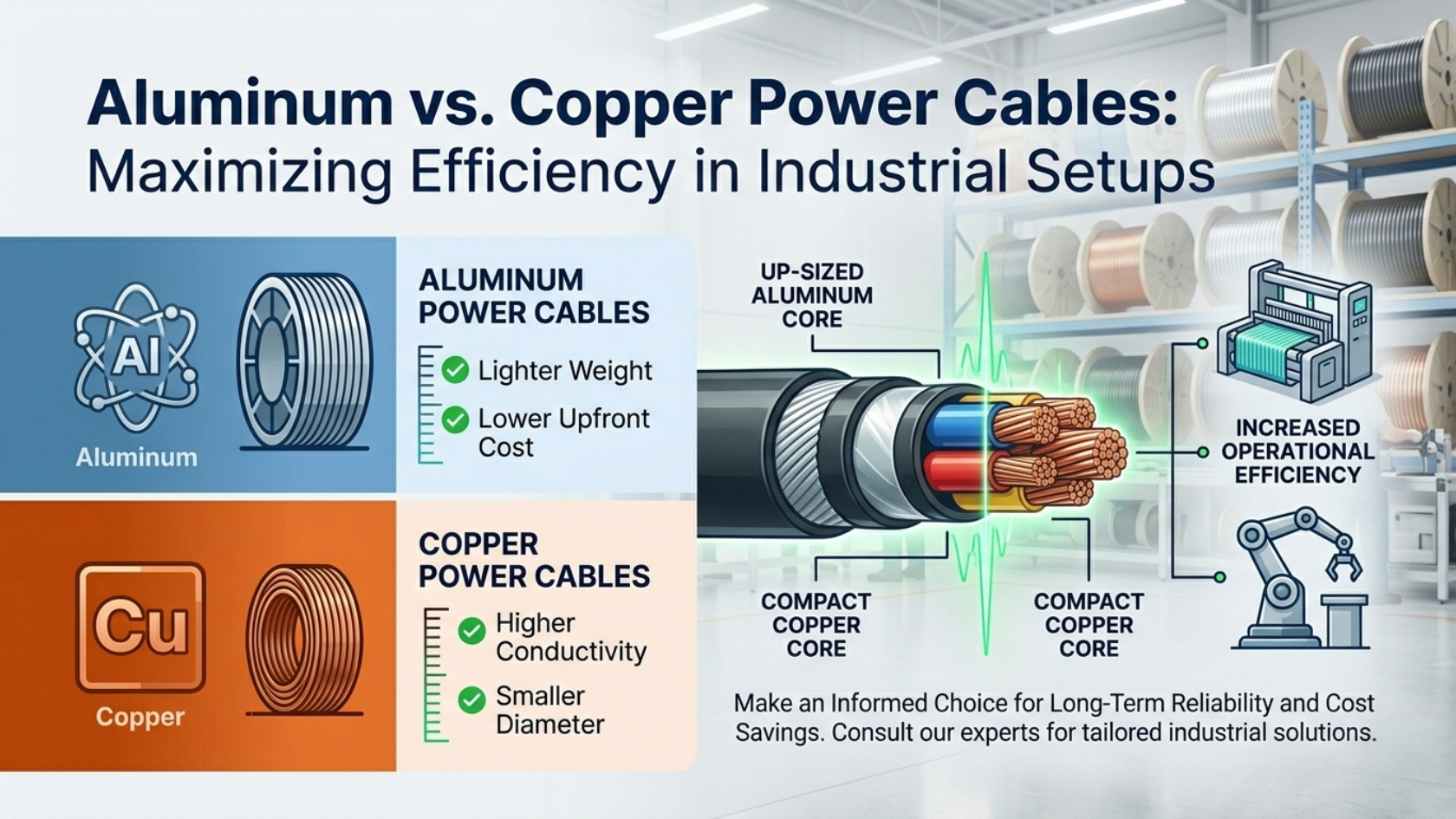
In large-scale industrial operations—whether running heavy textile machinery, manufacturing plants, or cold storage facilities—the power distribution network serves as the backbone of production. When designing or upgrading an industrial electrical grid, engineers and facility managers face a critical decision that impacts both immediate capital expenditure and long-term operating costs: Should you install Aluminum or Copper power cables?
This choice involves far more than comparing the initial price per meter. In industrial environments, choosing the wrong conductor material can result in severe voltage drops, massive energy losses as heat, and catastrophic connection failures.
To achieve maximum electrical efficiency and minimize system downtime, it is essential to understand the technical and economic trade-offs between aluminum and copper power cables.
1. Electrical Conductivity and Energy Loss
The primary performance indicator of any industrial power cable is its ability to carry heavy current loads with minimal energy loss.
- Copper Conductors: Copper is the gold standard for electrical conductivity, operating at 100% on the International Annealed Copper Standard (IACS). It features incredibly low electrical resistivity, meaning electricity flows smoothly with minimal power converted into wasted heat energy.
- Aluminum Conductors: Aluminum has roughly 61% of the conductivity of copper. To safely carry the exact same electrical current (ampacity) as a copper wire, an aluminum cable must have a cross-sectional area that is 1.5 to 1.6 times larger.
The Efficiency Verdict: If server rooms, precise machinery, or confined spaces limit your layout, copper delivers superior efficiency in a significantly smaller, more compact cable footprint. However, if an aluminum cable is properly up-sized to the correct larger gauge, its total electrical resistance matches the copper alternative.
2. Weight, Span Length, and Structural Load
Where aluminum loses ground in raw conductivity, it excels in low density and lightweight performance.
- Aluminum is approximately 70% lighter than copper.
- Even though an aluminum cable must be physically thicker to match copper’s ampacity, it remains significantly lighter than a copper counterpart handling the same load.
The Efficiency Verdict: For long-distance infrastructure runs, overhead transmission lines, and heavy-duty grid feeds across large factory yards, aluminum is the superior choice. Its light weight simplifies handling during complex installations, reduces labor strain, and heavily minimizes the structural load placed on cable trays, poles, and support racks.
3. Thermal Expansion and Connection Reliability
Industrial setups are notorious for cyclic loading—machinery powers up, draws massive current, generates heat, and then cools down when production cycles end. This constant temperature flux tests the physical limits of your wiring.
- The Aluminum Risk: Aluminum exhibits a significantly higher coefficient of thermal expansion and contraction compared to copper. Over time, this constant expanding and shrinking can cause standard screw-type terminal connections to loosen. Loose connections increase resistance, spark severe heat buildup, and present a high risk of electrical fires. Furthermore, aluminum quickly forms a resistive oxide layer when exposed to air, which can degrade the terminal joint if untreated.
- The Copper Advantage: Copper is highly stable under intense temperature swings, mechanically resilient, and far more forgiving at connection joints.
The Efficiency Verdict: For critical indoor distribution panels, motor control centers (MCCs), and high-vibration machinery connections, copper ensures absolute long-term reliability and requires far less frequent maintenance shutdowns. If aluminum is used for primary feeders, installers must use specialized bimetallic lugs and anti-oxidation compounds to lock in a safe connection.
4. Balancing Capital Cost vs. Lifetime Performance
For most procurement managers, budget constraints drive the final decision.
| Metric | Copper Power Cables | Aluminum Power Cables |
| Conductivity (IACS) | 100% (Excellent) | ~61% (Requires larger gauge) |
| Material Weight | Heavy & dense | 70% Lighter |
| Initial Material Cost | Premium pricing | 40% to 60% Lower |
| Maintenance Need | Low / High stability | Regular connection torque checks |
| Best Application | Confined routing, heavy machinery | Long-distance feeders, outdoor grids |
While aluminum offers an immediate 40% to 60% savings on raw material costs, it demands meticulous installation practices, specialized hardware, and thicker containment paths. Copper demands a premium upfront investment but rewards the facility with decades of lower maintenance overhead, higher physical durability, and maximum compact power delivery.
Secure Engineered Power Cables Factory-Direct from MK Cables & Solar
Whether your facility requires the raw, uncompromised performance of 99.9% Pure Copper Building Wires or the budget-optimized efficiency of heavy-duty Aluminum Power Cables (Full Gauge), the source matters.
At MK Cables & Solar, based out of Makkah Commercial Market, Faisalabad, we manufacture industrial-grade power cables tested to withstand intense operational heat, heavy cyclic loads, and harsh industrial environments. We provide certified, full-gauge cross-sections that guarantee your facility achieves maximum ampacity with zero performance compromises.
🏢 Optimize Your Plant’s Electrical Infrastructure: Don’t let under-gauge wiring drain your profits. Visit our commercial outlet in Faisalabad or tap “Message us“ to consult our technical engineering team for custom manufacturing runs and direct B2B wholesale pricing.